At a glance
Height: some 7,570 m, the tallest mountain in Bhutan
Where: the far north of Bhutan, on a disputed stretch of the border with Tibet
Name: commonly translated as the White Peak of the Three Spiritual Brothers
1985: a Japanese expedition reached nearly 6,900 m
1986: Steven Berry's British expedition reached around 6,700 m and turned back in October
Since 1994: no climbing above 6,000 m; by the early 2000s, no mountaineering at all
Today: never climbed, by most accounts the highest unclimbed mountain on Earth
In the far north of Bhutan stands Gangkhar Puensum, rising some 7,570 metres above sea level, the tallest mountain in the country.
It began rising nearly 50 million years ago, when India drove into Eurasia and pushed the Himalayas skyward; people arrived in the valleys beneath it only in the last sliver of that time.
Those who settled here learned to live with the mountains: their seasons, forests and rivers, and the hardship of travelling through them. Over thousands of years, that familiarity grew into an understanding of the landscape that still shapes communities across the Himalayas.
And there they stood, these ancient giants, watching generations come and go beneath their shadows. They inspired reverence, stories and whole traditions of worship. And somewhere along the way, as people tend to do when faced with something extraordinary, someone wondered what it would be like to stand on top.
That curiosity is wonderfully human. To look at something that has existed for millions of years, something that dwarfs everything around it, and decide you would like to climb it.
The first attempts
In 1985, a Japanese expedition led by Michifumi Ohuchi attempted the summit. They reached nearly 6,900 metres before one climber developed a life-threatening form of altitude sickness, forcing the team down.
The following year, a British mountaineer named Steven Berry arrived in Bhutan with the same ambition.
Berry had spent more than two years preparing. His journey brought him to Thimphu during the annual religious festival at Tashichho Dzong, where Black Hat dancers moved to ceremonial horns, drums and cymbals, and masked performers brought ancient stories to life before a packed courtyard.
It was a fitting introduction to a country where spirituality extends from the monasteries into the mountains themselves.
A sacred landscape
Across Bhutan, mountains, forests, rivers and lakes have long been held sacred. Some are dwelling places of protective deities; in other traditions, the mountains are divine beings in their own right. Gangkhar Puensum, whose name is commonly translated as the White Peak of the Three Spiritual Brothers, belongs to this sacred landscape.
This changes what it means to climb.
For a mountaineer, the summit is an extraordinary personal ambition. It demands courage, endurance and a willingness to face dangers that grow with every metre. There is something admirable in a person deliberately choosing the difficult path and discovering the limits of their own strength.
Now approach the same mountain through a tradition in which the mountain itself is sacred. It commands respect through its sheer presence, through the hardship of life around it, and through the rivers, forests and valleys that sustain the communities beneath it. Its slopes carry stories and responsibilities passed down through generations.
When a mountain is sealed
In the village of Soenakhar in eastern Bhutan, a protective mountain deity called Khobla Tsen is honoured each year through a ritual called tsensöl. Villagers gather in a forest clearing with offerings and prayers for the protection of their community and harvests. The ritual opens ladam, a season in which the higher mountain areas are closed to entry and resource collection.
Once the ceremony is complete, the mountain is considered sealed.
Over generations, a belief becomes a custom, and a custom becomes a shared responsibility. Suppose someone proposed to cut down that forest. The trees could not object, but the people who grew up with their stories could, and would. Protecting the mountain has become a way of protecting something within themselves. In that sense, the mountain has been given a voice.
Nine days in the clouds
Meanwhile, Berry's expedition was travelling deeper into Bhutan.
The approach took nine days on foot, through remote valleys, high passes and sacred lakes. Their Bhutanese companions warned them not to throw stones into certain lakes, for fear of disturbing the gods.
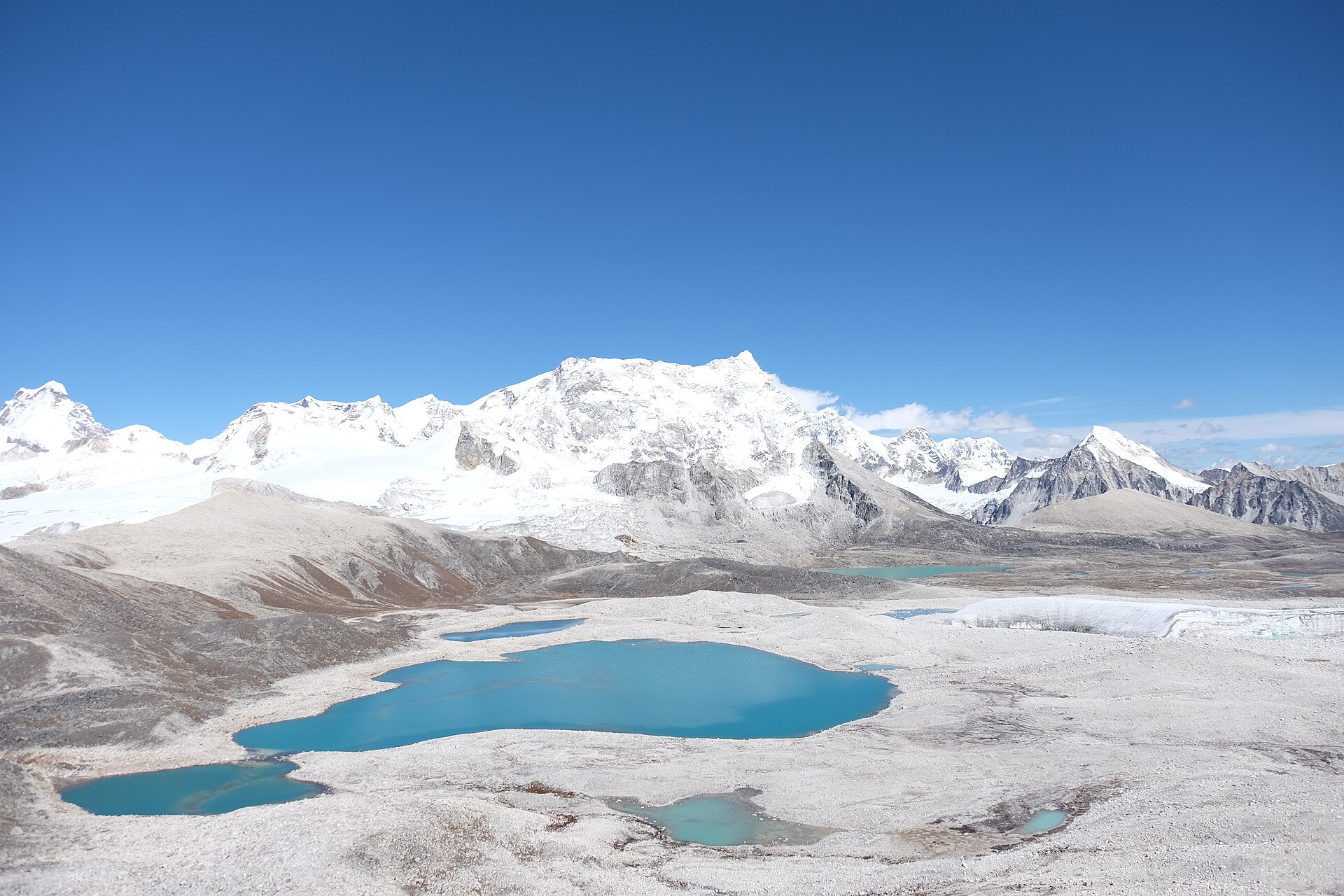
Gangkhar Puensum from Gophu La, with glacial lakes below.
For nine days, clouds hid the mountain they had come so far to climb.
Then, shortly after the team reached base camp, the clouds cleared. Gangkhar Puensum appeared, its sharp southern ridge rising to a pointed summit high above the surrounding peaks. After nine days hidden, the mountain had granted them its darshan, revealing itself as deities sometimes do.
Berry described a mountain of extraordinary beauty and difficulty. The team fixed ropes across steep ice and rock, set up camps and worked their way upwards, eventually reaching around 6,700 metres, where knife-edged ridges and ferocious winds made progress increasingly dangerous. At one point the wind was so strong that the climbers had to shout into each other's ears to be heard. Even breathing into it was a struggle.
In October 1986, the expedition turned back.
Gangkhar Puensum remained unclimbed.
Leaving the summit alone
In the years that followed, Bhutan closed its mountains. In 1994, climbing peaks above 6,000 metres was prohibited, and by the early 2000s mountaineering had been banned altogether, out of respect for the mountains' spiritual significance and the communities who live beneath them. Its position along a disputed stretch of the border with Tibet has kept it off-limits from the north as well.
Today, Bhutan builds roads, schools and hydropower while keeping conservation and culture at the centre of what it calls progress.
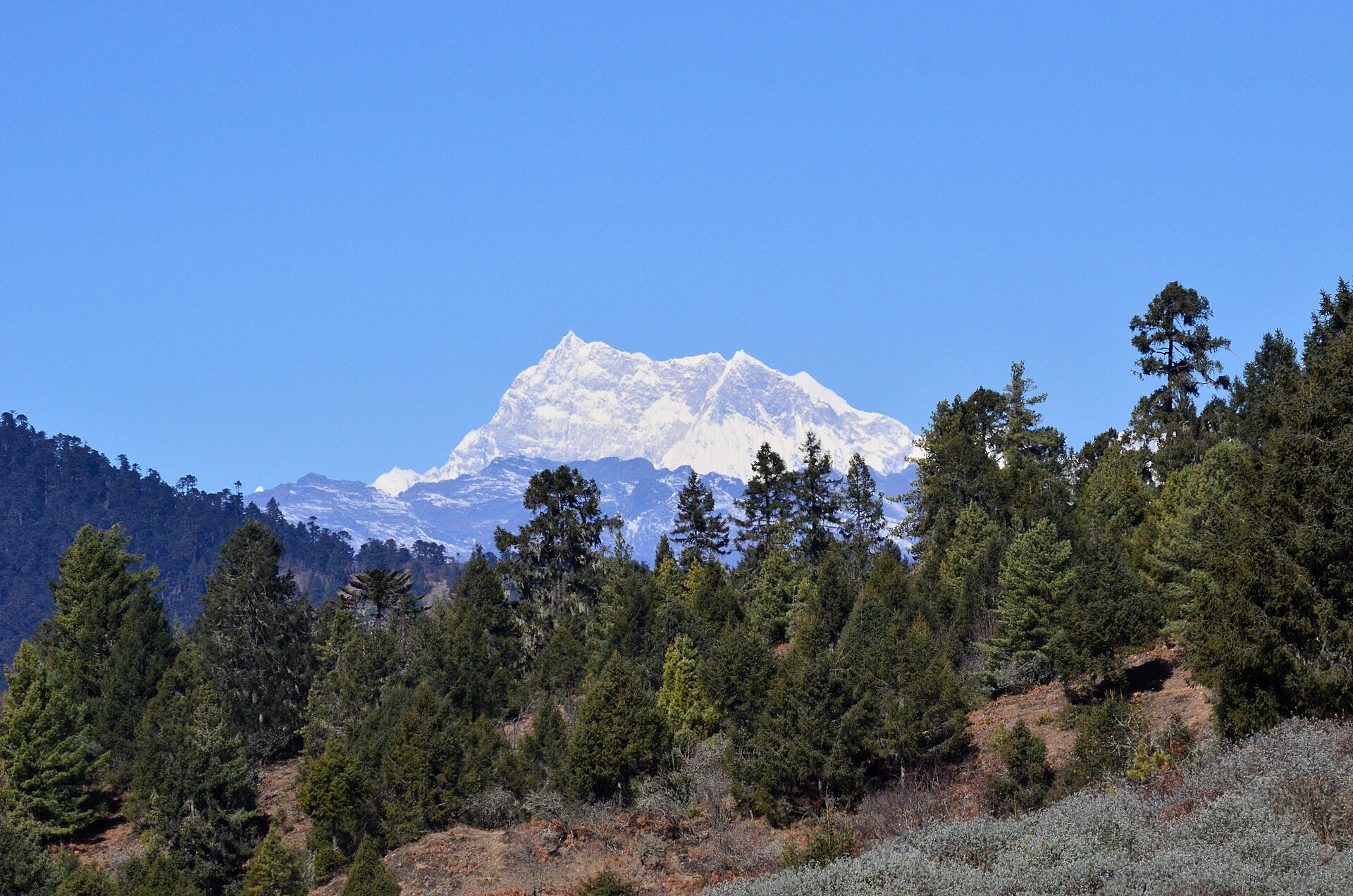
Gangkhar Puensum from the road between Jakar and Ura, in Bumthang.
We usually measure progress by the obstacles we overcome and the growing power we gain to change the world around us. Bhutan suggests another measure: recognising the value of what already exists, and deciding how our ambitions should meet it.
For the mountaineer, there is greatness in attempting a summit that others before him failed to reach. For a community beneath that same mountain, greatness can also lie in keeping a relationship that has endured for centuries.
Perhaps both begin with the same feeling: that sense of being small before something much greater than ourselves.
Berry left Bhutan with an unfinished expedition. Years of preparation, nine days through the valleys, a hard climb through rock and ice, and the summit still beyond reach.
And somewhere beyond those valleys, Gangkhar Puensum continued to stand.
Its summit remains untouched to this day, which makes it, by most accounts, the highest unclimbed mountain on Earth.
Perhaps there is something equally extraordinary about a people who have learned to find greatness in leaving it that way.
Sources
Photographs from Wikimedia Commons: the summit and the view from Gophu La by Gradythebadger (CC BY-SA 4.0); the view from Bumthang by Christopher J. Fynn (CC BY-SA 4.0).