
The week in numbers
Leave: seven days, both travel days included
On the ground: six days, five nights
Valleys: Paro, Thimphu and Punakha
Highest drive: Dochula, 3,080 m
Highest walk: Taktsang, 3,120 m
Longest drive: 120 km, Punakha to Paro
Road distance: about 250 km in all
Best months: March to May, late September to November
Distances from our own itinerary data. Drive times are estimates; see below for why.
A week of leave gives you six days on the ground in Bhutan's western valleys: Paro, Thimphu and Punakha, with the walk to Tiger's Nest at the centre and real time between the stops. It isn't enough to add Phobjikha or Bumthang without turning the week into a drive. A good week is defined as much by what it leaves out as by what it includes.
Seven days is really four
Most disappointment starts here, so it is worth saying first. The first day is the flight into Paro, usually after an overnight connection through Delhi, Kathmandu, Bangkok or Singapore, landing mid-morning. The last is breakfast and the drive to the airport. Between them are four full days, and those four days are the itinerary.
It matters for the fee too. The Sustainable Development Fee is charged per night, so a week is five nights, not seven. If a quote counts seven, ask which nights it means.
Four full days is what a week in Bhutan is. Every good decision about the itinerary starts there.
The week, day by day
Day one: into Paro, on to Thimphu. The approach to Paro is one of the more memorable landings anywhere, a banking descent between ridges into a valley at 2,250 metres. Then 55 km along the river to Thimphu, stopping at Chuzom, where the Paro and Thimphu rivers meet beside three stupas in three different styles. We leave the afternoon free. You have been travelling and you are now at 2,400 metres, so a walk through the craft bazaar and an early night is the useful thing. Thimphu famously has no traffic lights; the more interesting part is the ordinary working city underneath.
Day two: Thimphu on foot. A walking day rather than a driving one. Start at Buddha Dordenma above the valley and come down the Buddha Nature Trail, two hours through pine, birch and rhododendron hung with prayer flags, to Changangkha Lhakhang, a twelfth-century temple above the town. In the afternoon: the paper-making workshop, the post office and Trashichhoedzong, home to both the government and the central monastic body. About six kilometres on foot, all between 2,300 and 2,600 metres. It is the acclimatisation day, dressed up as sightseeing on purpose.

Buddha Dordenma, above Thimphu: the start of the Nature Trail rather than a viewpoint.
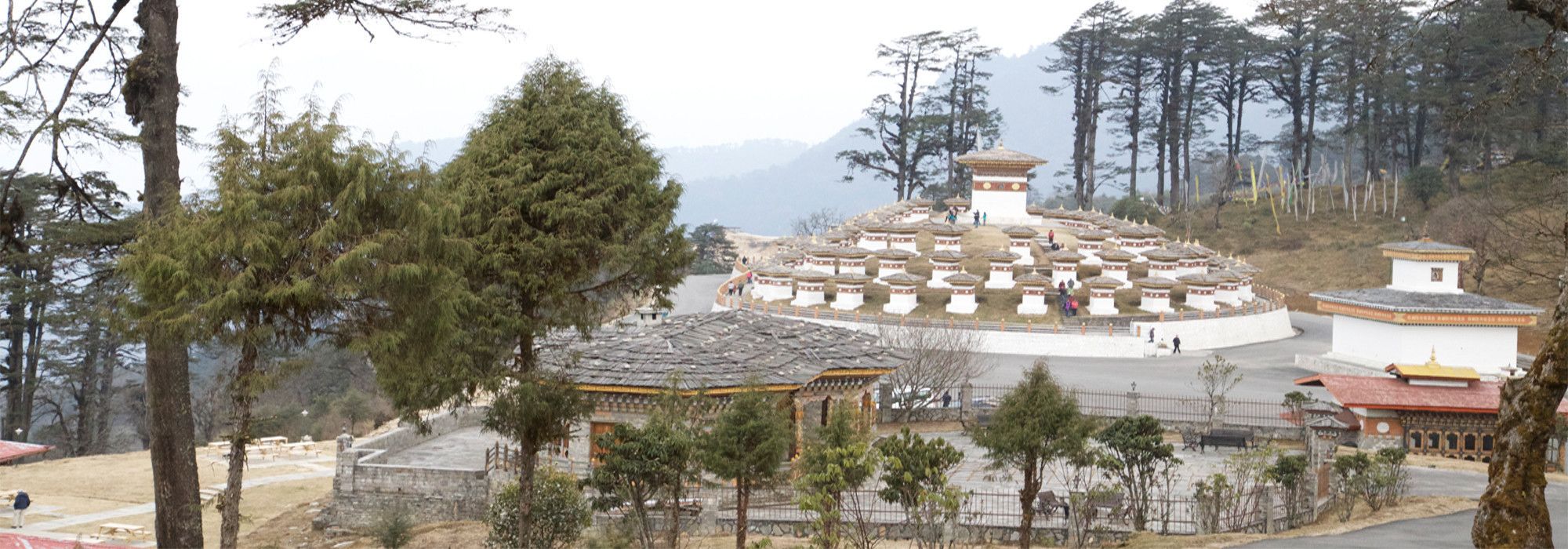
Day three: over Dochula to Punakha. 75 km east over the Dochula pass at 3,080 metres. On a clear morning the eastern Himalaya stands behind the 108 memorial chortens; on a cloudy one you get the chortens and the flags and not much more, and nothing can be arranged around that. Then the long descent to 1,300 metres, into a warm valley where the rice is growing. The twenty-minute walk through paddy and village lanes to Chimi Lhakhang is the best short walk of the week, and Punakha Dzong, at the meeting of the Mo Chhu and Po Chhu, is the building people remember longest.

Punakha Dzong: at 1,300 metres, the warmest and lowest point of the week.
Day four: the long drive to Paro. The one long day in the vehicle, 120 km back over Dochula and west to Paro, climbing from 1,300 to 2,250 metres. It is the price of Punakha and worth paying, but it should be planned as a driving day, not discovered as one. We break it at Simtokha Dzong, the oldest fortress in the country and right on the route. In Paro, the National Museum in the old watchtower, then down to Rinpung Dzong and its painted galleries.
Day five: Tiger's Nest. The day the week is built around: about 10 km there and back, 870 metres up from the road head to the monastery at 3,120 metres, roughly five hours on foot, starting at seven. It comes on day five rather than day two because by now you have spent four days between 2,300 and 3,100 metres and crossed Dochula, so the altitude has been dealt with quietly along the way. The afternoon is light on purpose: Drukgyel Dzong and Kyichu Lhakhang, both short and close. The walk itself is described here.
Day six: home. Breakfast and the drive to the airport, and that is all it should be.
Distances, not minutes
We know the distances exactly: 55 km from Paro to Thimphu, 75 km to Punakha, 120 km back to Paro. What turns them into hours is the road, where 30 to 40 km an hour is normal and roadworks, weather and livestock all change it. As a working guide, Paro to Thimphu is comfortably under two hours, Thimphu to Punakha around three with the stop on the pass, and Punakha back to Paro four hours or more with its stops. We would rather give you an honest estimate than a precise-looking guess.
What we leave out, and why
Phobjikha is about three hours beyond Punakha, on top of a week that already has one long drive; adding it costs a day each way for one day in the valley. Give it ten days, or a winter journey built around the cranes. Bumthang, the Buddhist heartland, is further east still and needs twelve days or more to be anything but a drive. Haa and the Chele La pass are spectacular, but they compete with Tiger's Nest for the week's only spare slot, and fit neatly into an eighth or ninth day. And a trek isn't something you slot into a cultural week. Even one night out needs its own arrangements.
The day most weeks overload is day three: the pass, the descent, the fertility temple and the dzong, with the suspension bridge, a farmhouse lunch and a second temple all tempting. Each is worth doing. The cost shows up two days later, at the bottom of the Taktsang climb, when someone who has had four fourteen-hour days looks up at 870 metres of ascent and decides to wait at the cafeteria. We have watched it happen. So we keep day three to the pass, Chimi Lhakhang and the dzong, and keep the afternoon of day four shorter than it could be.
Where the slack is
There is spare room in this week, just not a rest day; six days is too short for one. The free first afternoon absorbs a late flight. The light afternoon on day four absorbs a foggy pass or a slow road. And day six sits behind the big walk, so if day five is rained out, the walk can move for anyone on an afternoon flight. That is why Tiger's Nest is never on the last day.
What the week doesn't have is room for illness or altitude trouble. That is a limit of six days rather than a design fault, and the best argument for taking eight or ten.
Eight days is the single best upgrade, and not because you see more: an extra night in Punakha lets the whole week breathe. Ten days opens Phobjikha properly, and twelve makes Bumthang reasonable rather than heroic. The Sacred Valleys is this week as we run it. With more days, the Heart of Druk reaches Phobjikha and Bumthang without squeezing anything, and the Bumdra Sky Camp adds a night on the ridge and reaches Taktsang from above.
Sources
Our itinerary data: distances, elevations and the day structure, matching the Sacred Valleys page; drive times are estimates from those distances. Bhutan Tourism FAQs: the guide requirement and the per-night fee.


