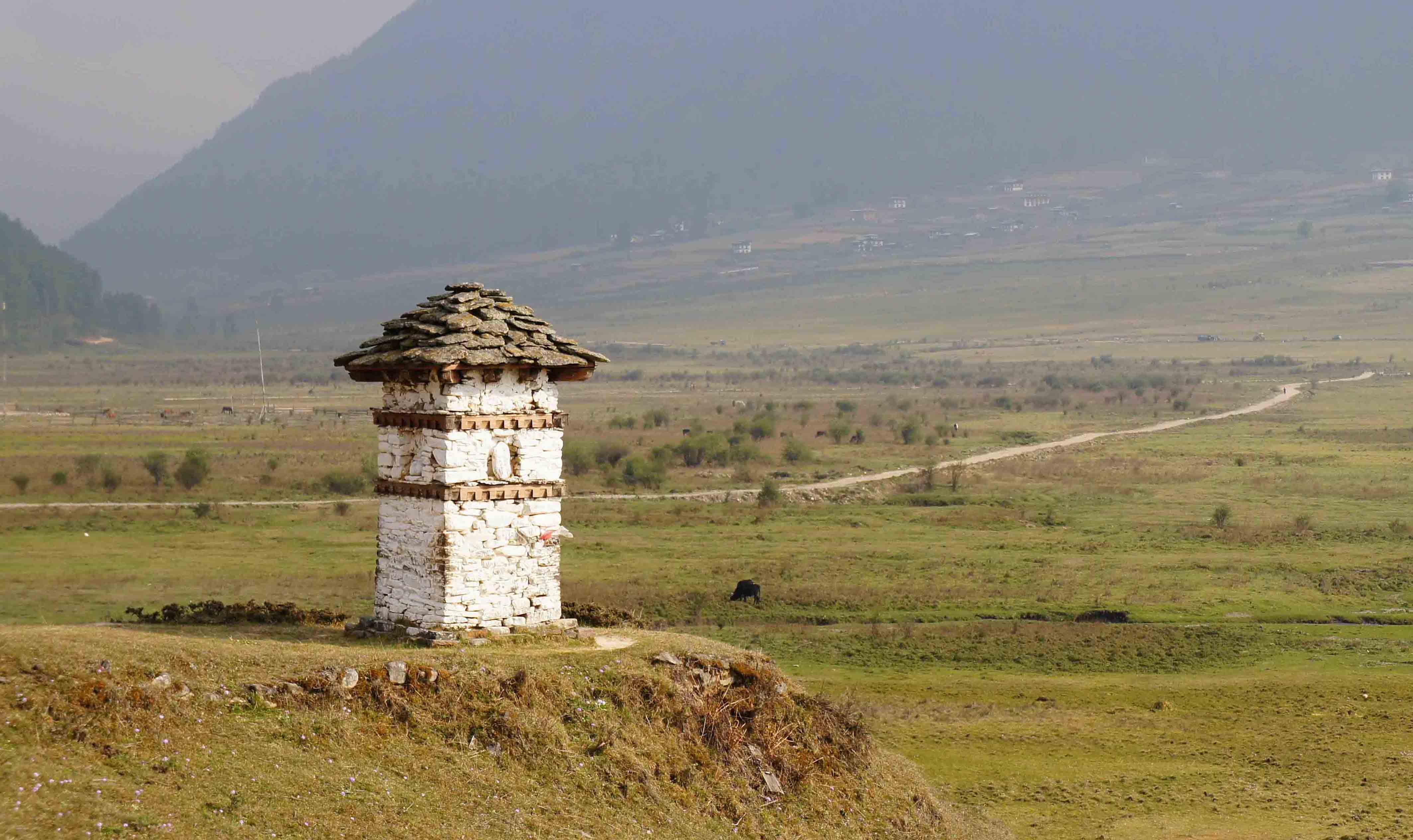
What to pack for Bhutan: valleys, monasteries and mountain weather


Pack for a 10 to 15 degree swing between afternoon and dawn, not for an average temperature. Three light layers beat one warm coat everywhere in Bhutan. Cover shoulders and knees for monasteries and dzongs — long trousers and sleeves, which is a requirement rather than a courtesy. Add broken-in walking shoes, a shell, and sun protection you will actually use at altitude.
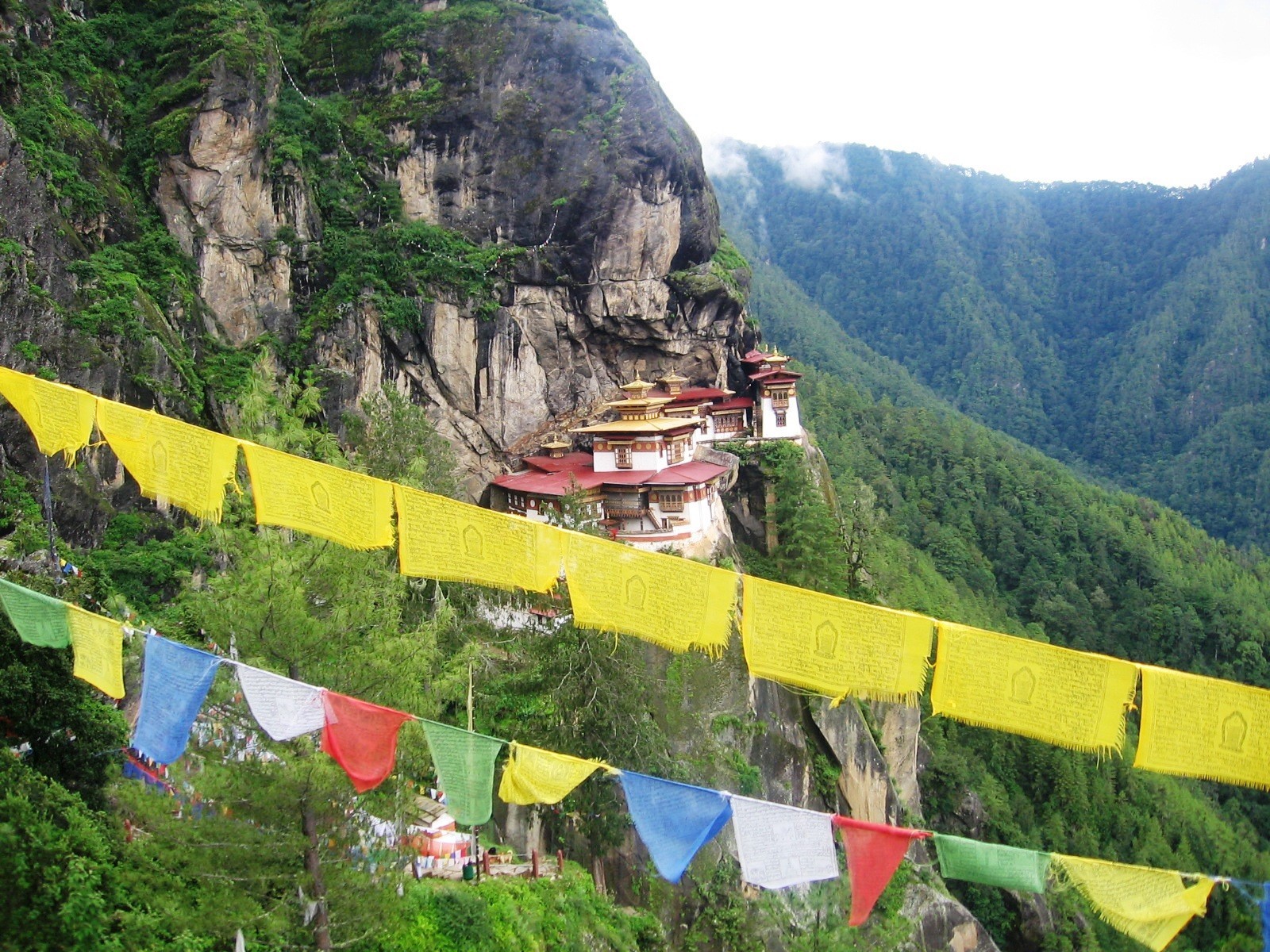
The Paro valley from the Taktsang trail. Most of a cultural week is spent between 1,300 m and 3,100 m.
The short list
The principle — layers, not bulk. Three thin things, not one thick thing.
Non-negotiable — long trousers and sleeves for monasteries and dzongs.
Footwear — walking shoes or light boots you have already worn in.
Outer layer — a windproof, showerproof shell in every season.
Sun — high-factor sunscreen, lip balm, sunglasses. The altitude does the damage, not the heat.
Daypack — 20–25 litres, enough for water, a layer and a camera.
Water — a refillable bottle; two litres of capacity for the Taktsang day.
Power — type D, F and G sockets appear; a universal adapter is the safe answer.
Most over-packed — heavy coats, formal clothing, and a second pair of boots.
Most forgotten — lip balm, a head torch, and any regular medication in its original packaging.
This covers a cultural journey through the western valleys in any season. Trek kit is a separate list, and it is not this one.
Who this is for
This is for someone with a confirmed journey who wants to pack once, correctly.
Anyone travelling a cultural route through the western valleys — Paro, Thimphu, Punakha — in any season.
Anyone who has read a list telling them Bhutan is cold and another telling them it is warm, and wants to know which.
Anyone unsure what ‘modest dress’ actually means in practice at a dzong.
Who this is not for
Anyone going on a supported trek. Sleeping at 4,000 m is a genuinely different kit problem, and treating this list as sufficient for it would be a mistake we do not want to cause.
Anyone looking for brand recommendations. What matters here is the system and the fit, and the shoes you already own and have walked in beat the better shoes you buy the week before.
Why is the daily swing the number that matters?
Because Bhutan’s weather is governed by altitude and sun far more than by season, and a single week routinely crosses 1,800 metres of it. On a standard western route you sleep at 2,400 m in Thimphu, drop to 1,300 m in Punakha where the rice grows, cross a pass at 3,080 m, and walk to 3,120 m at Taktsang.
The practical effect is a large gap between a sunny afternoon and the hour after sunset — commonly 10 to 15 degrees, and more at altitude and in clear winter air. A single warm coat solves the evening and is dead weight from ten in the morning. Three light layers solve every hour of the day, and the one you are not wearing lives in a daypack.
Base. A merino or synthetic t-shirt. Two or three; they do not need washing daily and cotton does.
Mid. A light fleece or a thin down or synthetic jacket that compresses into nothing. This is the layer that does the most work.
Shell. Windproof and showerproof. Wind on a pass at 3,080 m is what makes a pleasant day cold, and rain is possible in every season.
Pack for the swing, not the average. The average temperature in Bhutan is a number you will never actually experience.
What does the dress expectation actually require?
Shoulders and knees covered in monasteries, dzongs and temples. In practice: long trousers, and sleeves rather than a vest. Hats come off inside. Shoes come off where your guide’s do.
It is worth understanding this as a reason rather than a rule, because the reason tells you where the edges are. Dzongs are working administrative and monastic buildings — the district government sits in them and monks live in them. Bhutanese visitors attend in the national dress, gho and kira, with a formal scarf added for the inner courtyards. The expectation on you is not equivalence; it is simply that you are recognisably dressed for a place where people are working and praying. Nobody will measure your hemline. Someone will notice a vest.
That is also why a single pair of long trousers you find comfortable is worth more than three pairs you tolerate. You will be wearing them almost every day.
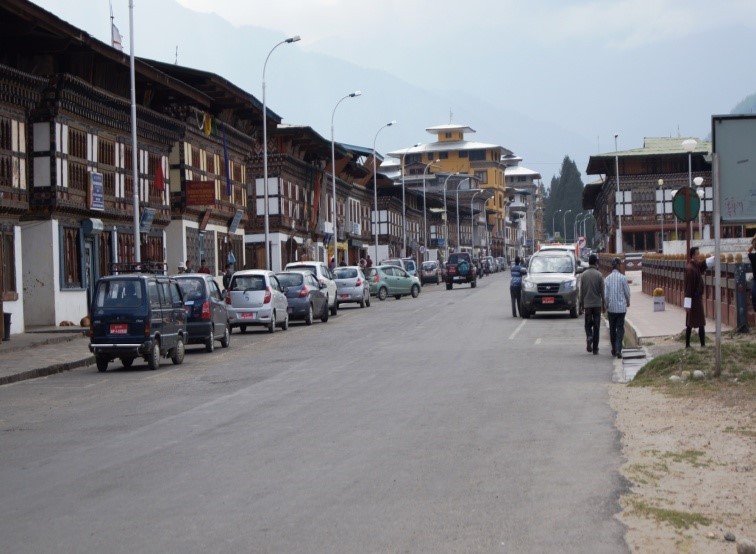
Thimphu, at 2,400 m. Bright afternoons and cold evenings are the pattern for most of a western itinerary.
What changes by season?
What to add, by season, on top of the base list above
Spring, March–May
Add — a proper rain shell; layers for cold mornings that turn into warm afternoons.
Leave behind — heavy insulation. The valleys warm quickly.
Summer, June–August
Add — a genuine waterproof, quick-drying trousers, sandals for the evening, insect repellent.
Leave behind — anything that takes two days to dry, and most of your warm kit.
Autumn, late September–November
Add — a warm mid-layer for the evenings; the days are bright and the nights are not.
Leave behind — heavy waterproofs. This is the dry window.
Winter, December–February
Add — a hat, gloves, a warm mid-layer, and thermal base layers if you feel the cold. Nights at altitude drop below freezing.
Leave behind — nothing. This is the season to bring the warm things.
Two constants across all four: sun protection and a windproof layer. At 3,000 metres the sun burns in a way the air temperature does not warn you about, and wind is what turns a comfortable pass into a cold one.
General footage of movement through Bhutan’s landscape across several activities. It is not a single route or day, and we are not presenting it as one — it is here for a sense of the terrain the list above is written for.
What do people get wrong?
Over-packed: warm coats
The single most common excess. People read ‘Himalaya’ and pack for a mountaineering expedition, then spend the week carrying a coat they wear for two hours after dinner. Unless you are travelling in December or January, or sleeping at altitude, the down jacket that compresses to the size of a water bottle is the correct amount of warm.
Over-packed: two pairs of boots
One pair of comfortable walking shoes covers the Taktsang climb, the valley walks and the dzongs. A second pair is weight you will move between vehicles and never wear.
Forgotten: lip balm and sun protection
Consistently the item people ask for. Dry air, altitude and strong sun are a combination most visitors are not used to, and the effect shows up on day two.
Forgotten: a head torch
Not for adventure — for ordinary evenings. Power interruptions happen, monastery interiors are genuinely dark, and early starts happen before dawn.
Forgotten: medication in its original packaging
Bring any regular prescription in labelled packaging with a copy of the prescription. This is a border formality rather than a difficulty, and it is much easier before you travel than at the airport.
Our judgment — the two things we would actually insist on. Shoes you have already walked in, and a bottle you will actually refill.
On shoes: the Taktsang day is roughly 10 km with 870 m of ascent and about 1,400 steps in the gorge. New boots make that day about blisters instead of about the monastery. If the only walking shoes you own are old and comfortable, bring the old comfortable ones.
On the bottle: this is a small thing that adds up. Bhutan’s environmental position is not decoration — it is a country that constitutionally commits to keeping most of itself under forest — and a week of bought plastic sits badly in that context. Boiled and filtered water is available throughout, and we would rather refill you than sell you bottles.
What we will not do is tell you the temperature will be a specific number. We will tell you where you sleep each night and how high it is, which is a more useful prediction and one we can actually stand behind.
What do we provide?
What is settled: your luggage moves by vehicle on cultural routes, so a soft bag is easier than a hard case, and you are never carrying more than a daypack during the day.
What about a trek?
A supported trek is a different list, not a longer one. Sleeping above 3,500 m, a sleeping-bag rating that matches the camps, a duffel that a pack animal can carry, and a boot that handles wet ground for eight days rather than one — none of that is an extension of what is above.
We will publish that list separately — packing for a supported trek [NOT PUBLISHED YET — leave as plain text, do not link] — and it needs the equipment confirmation above before it can be useful. If you are booked on one of the Chomolhari routes, ask us and we will send the current list for your departure.
How this changes the journey. The list you need depends more on the route than the season. Sacred Valleys stays between 1,300 m and 3,120 m and never sleeps high — the list above is the whole of it. The Heart of Druk adds Phobjikha, which is meaningfully colder at night than anywhere else on a cultural route and is the one case where a winter-weight layer is not over-packing. The Chomolhari routes sleep at altitude for several consecutive nights and need the trek list.
Tell us which route and which month, and we will tell you what to leave at home.
Questions we are actually asked
Is there a dress code in Bhutan?
For monasteries, dzongs and temples, yes — shoulders and knees covered, meaning long trousers and sleeves rather than shorts or vests. Hats off inside, shoes off where your guide’s come off. Everyday dress elsewhere is unremarkable; the expectation is specific to religious and administrative buildings, which you will visit most days.
Do I need hiking boots for Tiger’s Nest?
Not necessarily. In dry conditions, trainers or walking shoes with grip are enough — the trail is a well-made path, not a scramble. After rain it turns slick and a boot with an edge helps. What matters most is that you have already walked in whatever you bring.
How cold does it get at night?
It depends on altitude far more than season. Punakha at 1,300 m is mild year-round; Thimphu and Paro at 2,250 to 2,400 m are cold after dark from autumn onward; Phobjikha at around 2,900 m drops below freezing on winter nights. Expect 10 to 15 degrees between the afternoon and the hour after sunset in any season.
Can I wear shorts in Bhutan?
Not in monasteries, dzongs or temples, which rules them out for most of a normal day. Long, light trousers are more comfortable than they sound and cover both the dress expectation and sun exposure at altitude.
What should I not bring?
A heavy coat unless you are travelling in deep winter or sleeping at altitude, a second pair of boots, formal clothing, and single-use plastic water bottles. Tobacco is restricted for import and heavily taxed; if you smoke, read the current rules before you pack.
What is the power supply like?
230V, with type D, F and G sockets all appearing depending on the building. A universal adapter is the reliable answer. Bring a power bank if you are photographing all day — charging opportunities are fine in hotels and non-existent on the trail.
Neri itinerary data — sleeping and walking elevations for every stop on every route, which is what the altitude-based guidance above is built on.
Bhutan Tourism FAQs — general visitor guidance and the season descriptions referenced here.
Neri field experience — what guests over-pack and forget is drawn from our own trips rather than published sources, and is stated as such. Dress guidance is locally reviewed practice; the temperature guidance is deliberately qualitative because we have no cited meteorological series to stand behind.
Start a conversation. Not sure which list applies to you? Tell us your route and month and we will send the specific version, including anything we provide.
Related Field Notes and next step
Monastery etiquette [NOT PUBLISHED YET — leave as plain text, do not link]
Packing for a supported trek [NOT PUBLISHED YET — leave as plain text, do not link]